
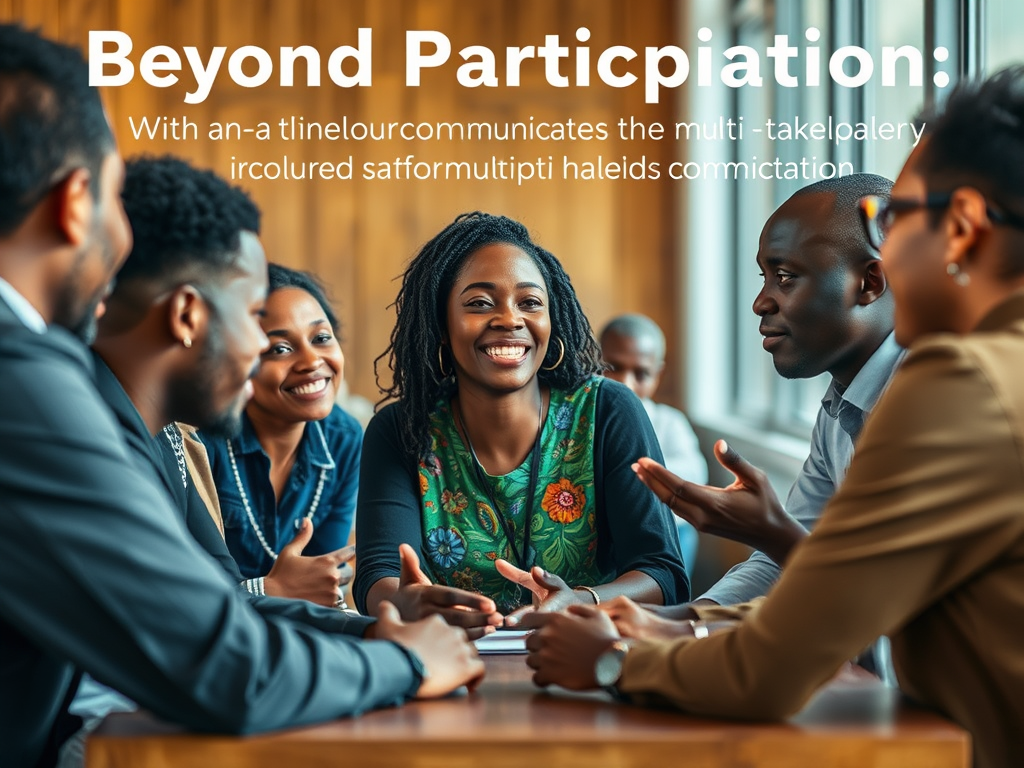
Beyond Participation: Why Farreach Is the Missing Link in Development Communication
Recently, I had the privilege of attending and actively participating in a multi-stakeholder engagement meeting. After the panel session, I found myself in conversation with two of the facilitators and the keynote speaker. As we exchanged reflections, a woman who I believe was the Executive Director of an NGO in South-East Nigeria joined us.
She asked a question that immediately shifted the tone of the conversation.
Why is it that participatory communication has long promised to make development more inclusive, effective, and sustainable, yet in practice, many “participatory” projects still fall short? Communities attend meetings. They contribute ideas. They give feedback. But real influence remains limited, and long-term impact often feels elusive.
What’s missing?
We all paused.
One facilitator responded first, offering a thoughtful explanation about the relationship between participation and project outcomes. The keynote speaker built on that point, expanding the conversation to structural and institutional constraints that often weaken participatory processes. Both responses were intelligent and well-articulated.
Yet something still felt incomplete.
When it was my turn to respond, my answer was simple:
The problem is not participation itself. The problem is how far participation actually reaches across people, across processes, and across systems.
And that is where the Farreach perspective becomes critical.
Participatory Communication: Necessary, But Not Sufficient
Participatory communication has been one of the most important correctives in development practice. It challenged top-down information delivery and reminded us that communities are not passive recipients of change. It emphasised dialogue, local knowledge, and shared problem-solving.
But too often, participation is treated as an event rather than a system.
We see it in familiar patterns:
- Participation is limited to consultation, not decision-making
- Engagement that ends once implementation begins
- Community voices are shaping activities, but not influencing institutions or policy
In such cases, projects may look inclusive on paper but remain unchanged at their core. Participation happens, but transformation does not.
Introducing the Farreach Perspective
The Farreach perspective builds on participatory communication, but it pushes the conversation further. It asks a more demanding question:
How far does participation actually travel, and what does it change?
Farreach reframes communication not simply as engagement, but as a system of influence. It focuses on three interconnected dimensions:
- Reach – Who is included? Who is still excluded?
- Depth – How meaningful is participation? How much agency do people truly have?
- Systemic Influence – Does participation shape decisions, structures, and outcomes beyond the project level?
In essence, Farreach shifts the focus from involvement to impact.
Farreach Framework — At a Glance
The Farreach Framework is a practical guide for designing and assessing participatory communication in development projects. It moves us beyond counting participants toward evaluating transformation.
It helps practitioners ask:
Reach
Who is genuinely included in communication processes and who remains invisible?
Are women, youth, informal actors, and grassroots groups structurally positioned to make meaningful contributions?
Depth
Are communities merely consulted, or are they co-creating solutions and shaping priorities?
Systemic Influence
Does community knowledge travel upward?
Does it inform budgets, strategies, institutional learning, or policy decisions?
Farreach matters because it enables teams to diagnose participation gaps, design stronger feedback loops, and assess whether engagement leads to measurable change across the project lifecycle.
Why Farreach Matters for Development Projects
1. Moving from Tokenism to Shared Power
Farreach helps distinguish symbolic participation from meaningful authority. It pushes projects beyond listening exercises toward shared ownership and decision-making power.
2. Building Communication Ecosystems, Not Events
Instead of isolated workshops or consultations, Farreach encourages ongoing communication systems, feedback loops, peer networks, and learning platforms that persist beyond project cycles.
3. Connecting Local Voices to System-Level Change
Perhaps most importantly, Farreach asks whether community insights influence organisational strategy, donor frameworks, and policy processes. Participation that does not travel beyond the room risks becoming performative.
What Farreach Looks Like in Practice
In a Farreach-informed project, communication is not an add-on. It is the infrastructure of change.
You might see:
- Community co-design processes that directly shape budgets and indicators
- Youth and women acting as knowledge producers, not just informants
- Participatory media linked to advocacy and institutional reform
- Continuous feedback mechanisms that inform adaptation, not just reporting
Here, participation becomes embedded, not episodic.
Confronting Power, Honestly
One of the strengths of the Farreach perspective is that it does not romanticise participation. It recognises that communication takes place within unequal social and institutional landscapes. Without deliberate design, dominant voices will naturally overshadow marginalised ones.
Farreach, therefore, demands intentional equity. It pushes practitioners to design participatory spaces that are:
- Inclusive by structure, not assumption
- Facilitated with attention to power dynamics
- Evaluated based on influence, not attendance sheets
Rethinking What Success Means
Traditional development metrics often ask:
How many people were reached?
Participatory metrics improve the question:
Who was involved, and how?
Farreach adds a third, more uncomfortable question:
What changed because people participated?
This shift is not academic. In a world grappling with climate crises, health inequities, governance failures, and widening inequalities, development cannot afford performative inclusion. It requires collective intelligence that reshapes systems.
From Participation to Farreach
Participatory communication remains foundational to ethical development practice. But participation alone is no longer enough.
The Farreach perspective invites practitioners, donors, and institutions to think beyond mere attendance, beyond mere consultation, and beyond symbolic engagement. It challenges us to design communication that travels further, goes deeper, and reshapes systems.
When participation truly reaches that far, development projects stop delivering solutions to communities and begin building futures with them.